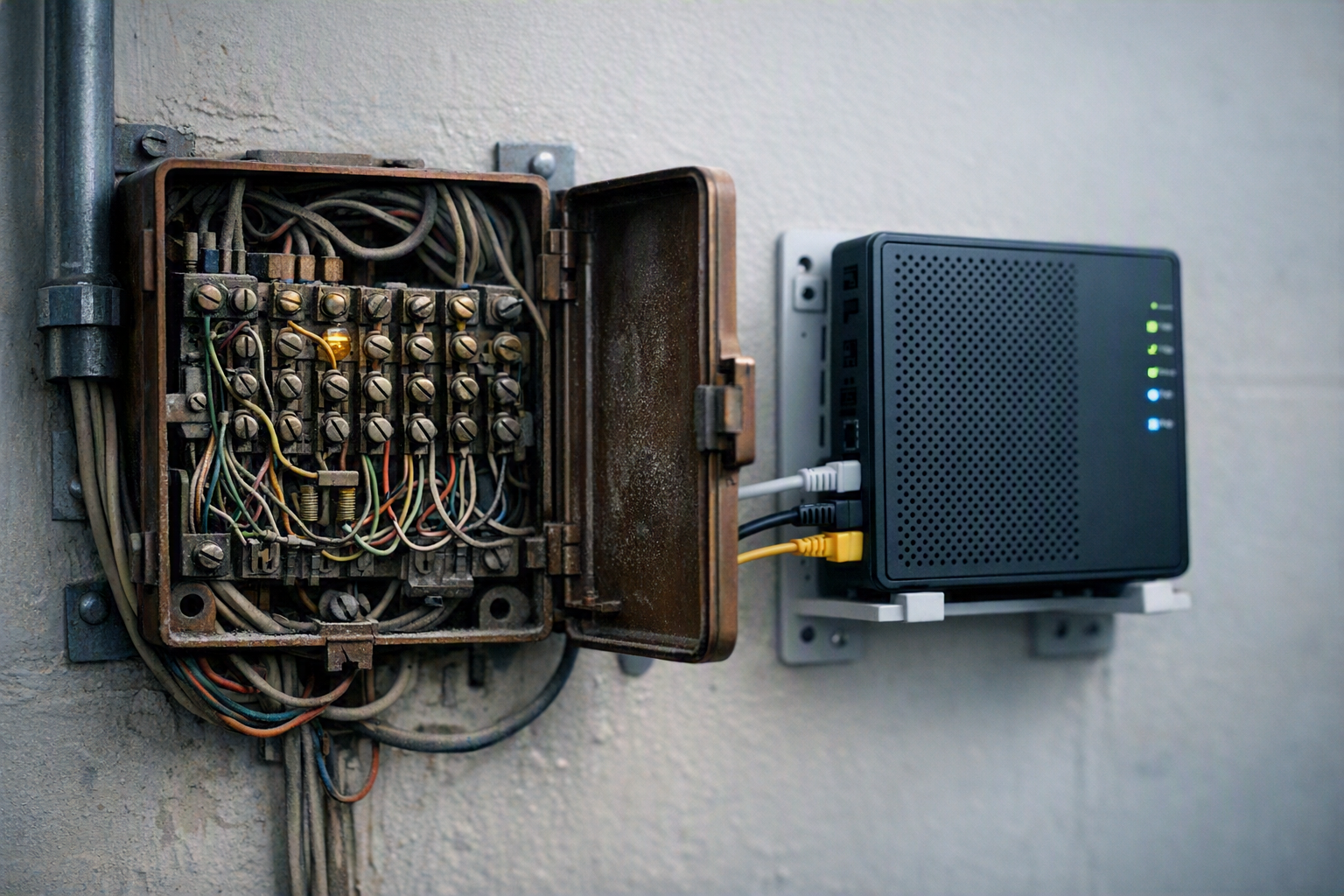
Six months from now the UK’s copper telephone network stops carrying calls. Around 1.5 million lines are still on it, roughly 350,000 of them at business premises, and a good number are running payment terminals, lift alarms, door entry systems and security panels rather than telephones (VoIP Review, 3 August 2026). Legacy systems look like a technology problem from the outside. From the inside they are almost always a programme somebody stopped finishing.
The comfortable reading of that 1.5 million is that some firms are slow. The more useful reading is that the last part of a large migration behaves nothing like the first part, and almost nobody plans it as a separate job.
The plan was working right up to the point it met the tail
“Last year, we were seeing over 80,000 migrations per week, and we felt really comfortable that we would meet the deadline of December 2025,” Openreach’s senior manager for All-IP migrations said in 2024, explaining why the switch-off was then reset by thirteen months to 31 January 2027 (Giacom, June 2024). The reset followed serious incidents on another provider’s network where telecare devices stopped working after customers were migrated. The industry paused non-voluntary telecare migrations at the end of 2023 (BBC, May 2024), and government then required enhanced protections, including a compatible working service in place before any telecare user is moved and a minimum hour of uninterrupted emergency access during an outage, before migrations could resume (The Register, May 2024). Nearly two million people in the UK use personal alarms that rely on a landline (BBC, May 2024).
Read the sequence again. The programme was hitting rate. What stopped it was a category of customer the plan had counted as a number and the operation had to handle as a case.
That is the shape of it. A migration plan is built on throughput: lines per week, sites per month, users per wave. The remaining fraction is a different kind of work measured in a different unit, and it arrives after everyone has already been told the thing is nearly done.
The exceptions are the actual work
What sits on those 1.5 million lines explains why they have not moved. Card readers. Lifts. Alarm panels. Gate barriers. A fax machine in the back office of a firm that swore it stopped using them a decade ago. Each one has an owner somewhere, a supplier contract, a maintenance arrangement, and a person who has to be on site when it changes. Openreach’s message to businesses is to check every service rather than only the voice lines (VoIP Review, 3 August 2026), which is a polite way of saying most firms cannot list what they have.
I built operations for a fibre broadband provider during its growth phase, and the work that consumed disproportionate management time was always the awkward minority. The address that did not match the database. The site with two owners and no agreed access route. The connection that worked perfectly well and had been recorded against the wrong exchange. Ten of those absorbed more senior attention than a thousand routine installs. A weekly rate has no column for them. They surface later, as the reason the rate stopped.
The general form is simple enough. A programme’s plan is built from the cases it can describe, and its ending is governed by the cases it cannot.
When price is doing the work a plan should have done
Legacy line prices went up 20 per cent on 1 April 2026 and a further 40 per cent on 1 July, with another 40 per cent scheduled for 1 October, taking the rental to double what it was a year earlier (The Register, 7 February 2026). Escalating price is a defensible lever. It is also a signal.
An organisation reaching for cost pressure to finish a job has usually run out of plan some time earlier, and the people who could see that coming stopped saying so.
That second half is the part worth taking personally. In most businesses the moment a delivery becomes doubtful and the moment anyone reports it are separated by weeks. The reporting tends to happen once the deadline has arrived and denial is no longer available. My own rule is that a threat to finishing gets raised on the day it becomes visible, in whatever half-formed state it is in, with no recovery plan attached and no requirement to have one. An early warning that is only half thought through beats a complete explanation delivered after the fact. Building that reflex into how a team actually reports takes longer than installing any system, and it is what buys the time to act.
The interim fix outlives the system it patched
Some customers have no broadband and do not want it, and around 1.8 million people rely on home telecare systems that were never built for a digital line (ISPreview, September 2025). So the industry built them a way to stay where they are. Openreach’s SOTAP Analogue sits in the exchange and replicates the old service without needing broadband, a router, an engineer visit or battery backup, and BT’s Pre-Digital Phone Line is the retail product on top of it. It ran as a pilot from May 2024 and launched commercially on 28 October 2025 at £127.80 a year wholesale (ISPreview, September 2025). It is described as interim connectivity (The Register, 7 February 2026), retiring as Openreach closes the exchanges that house it, which begins at full speed from 2030 (ISPreview, September 2025).
Look at the arithmetic. A network that was due to be gone in December 2025 will still be emulated for some customers at the turn of the next decade.
The uncomfortable part is how well that was done. Seventeen months from pilot to commercial launch, a published wholesale price, technical specifications, national availability, eligibility rules confining it to existing vulnerable and critical-infrastructure lines. A serious piece of engineering, built properly to close a gap the deadline could not, and it still carries a tail into the 2030s.
Most organisations acquire their architecture the same way with none of that care. The spreadsheet that bridges two systems because the integration slipped. The manual reconciliation kept going while the finance module gets fixed. The separate process for one region because that region’s data was not ready at cutover. Each is defensible on the day it is agreed. Each has a longer life expectancy than the thing it was patching, because the pressure that would have removed it disappeared the moment the programme was declared complete.
What legacy systems actually cost you
The cost hides in four places. First, in the people who hold the exception in their heads, since nobody else does. Then in the process built around the workaround, which every new joiner learns as though it were the design. It shows up again in the next programme, which has to be scoped around something that was supposed to be gone. And it sits in the risk, quiet until an external date, a failure, or a buyer’s diligence team brings it into the room.
That last one arrives with a bill. Diligence teams find manual workarounds quickly, because they ask the operational questions the business stopped asking itself years ago. A company carrying five years of deferred completions reads exactly as what it is, which is an operation that has never had to hold under a load it did not choose.
Finishing is a management discipline
Three things separate the businesses that finish from the ones that accumulate.
The first is a presumption of completion. Anything short of complete counts as a deviation that someone with authority has explicitly signed for, carrying a name and a date, rather than a condition the work quietly drifts into. When a programme closes with sixteen open exceptions, sixteen people own one each, and the closure paperwork says who.
The second is a register of open tails. Every programme declared complete in the last five years, and what each one left behind. Most businesses cannot produce that list, and the inability to produce it is itself the finding. The first honest look at how an operation really runs tends to surface workarounds older than half the people who depend on them.
The third is a rule about closure. A programme does not close over an open exception list. Either the list is cleared, or it moves into a named person’s standing objectives with dates against it, and the programme closes on that basis. Handing unfinished work to ordinary management is a legitimate ending. Losing track of it is the failure.
Six months is plenty of time to migrate 1.5 million lines, and larger numbers have moved faster. Whether it happens now depends on how much of that 1.5 million is attached to something nobody has looked at yet, a figure the businesses concerned do not themselves know. The version of that question for your own operation is narrower and less comfortable. What are you still running on a temporary arrangement, who agreed it was temporary, and when did anyone last check whether it still is.
References
- VoIP Review. “Openreach Warns Businesses as PSTN Switch Off Looms.” 3 August 2026. Read Article
- Giacom. “Openreach delay PSTN Switch Off until January 2027.” June 2024. Read Article
- The Register. “Openreach turns up the heat to force laggards off legacy copper lines.” 7 February 2026. Read Article
- ISPreview UK. “Openreach Launches Alternative UK Analogue Phone Line Product.” September 2025. Read Article
- BBC News. “Charity welcomes delay in BT digital telephone switchover.” May 2024. Read Article
- The Register. “BT delays deadline for digital landline switch off date.” 21 May 2024. Read Article