Most management assessments measure what other people think of you or what personality type you fit. The Individual Invincibility Blueprint does neither. It measures how you actually operate as a manager, using evidence you provide yourself, and produces a written report detailed enough to act on.
This article explains the methodology: what it measures, how the questionnaire works, what the report contains, and how it differs from alternatives you may have encountered.
What It Measures
The assessment evaluates 20 management competencies organised into three groups.
Character (competencies 1–7) covers how you manage yourself: your decision making, how you present and defend your decisions, your self-organisation, planning capability, self-development practice, emotional management, and how you build and use influence.
Structure (competencies 8–13) covers how you build and maintain the operating environment: delegation, control, regulation, discipline, exactingness, and coordination. These are the competencies that determine whether your management system works when you are not personally present.
Influence (competencies 14–20) covers how you work through and with people: encouragement, communication management, staff development, authority management, team formation, conflict management, and managing the operating system as a whole.
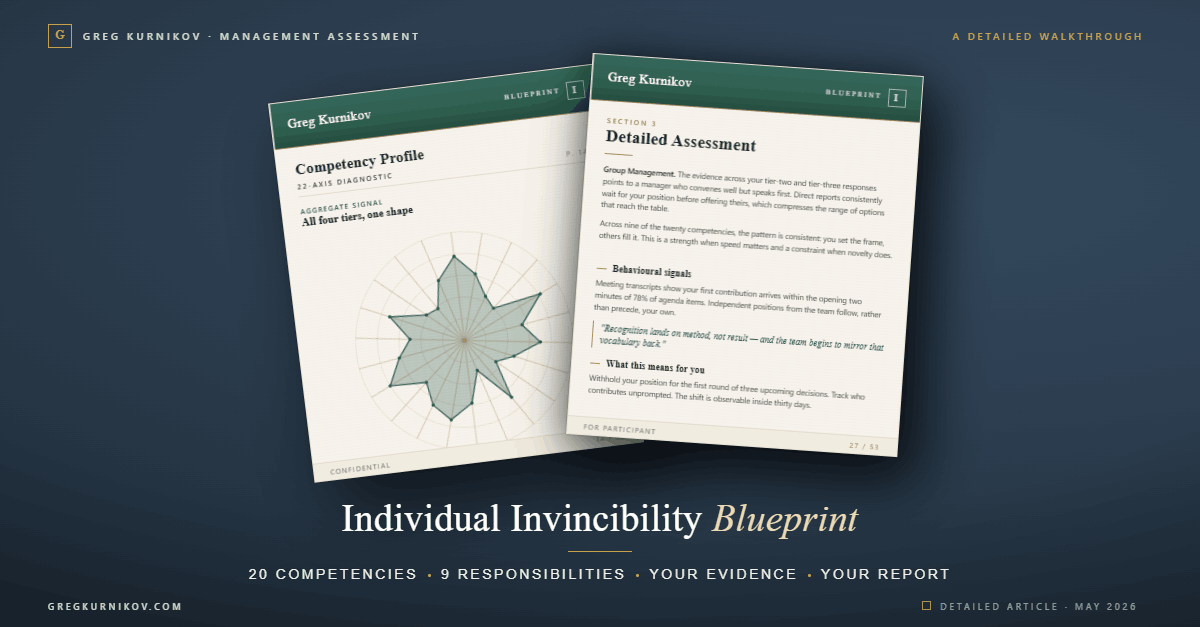
The assessment produces a competency profile displayed as a radar chart across 22 axes. An asymmetric profile is normal and diagnostic. Most managers are stronger in some areas than others, and the shape of that asymmetry is often more revealing than any individual score.
How the Questionnaire Works
Four tiers exist: Personal, Junior Manager, Mid Manager, and Senior Manager. Each tier has its own questionnaire. They are not simplified versions of each other. They are entirely different questions about entirely different situations, because the job at each level is fundamentally different.
A personal-tier participant is asked questions like: “Walk me through how your week actually works. What gets your time, and how much of that do you control?”
A junior manager is asked: “Tell me about a time you delegated something important and it did not go well. What happened, what did you do about it, and what would you do differently now?”
A mid manager is asked: “How do you know if your managers are managing well, or just keeping things afloat?”
A senior manager is asked: “If you left your current role for three months and no replacement was appointed, what would continue to work and what would stop?” And: “How do you know when the information reaching you has been filtered, softened, or distorted before it arrives?”
The questionnaire takes between 2 and 5 hours depending on the tier, not because the questions are complicated, but because they require you to think carefully about how you actually handle real situations rather than how you would like to handle them.
What the Report Contains
The report for manager tiers typically runs between 43 and 49 pages. Every finding traces to something the participant wrote. There is no generic advice and no filler.
Competency Profile. The radar chart shows the shape of the participant’s management across all assessed competencies. It is a diagnostic tool: where the shape is uneven, the report explains what that unevenness means in practice.
Detailed Assessment. Each competency is assessed individually with evidence drawn from the participant’s answers. One example from a sample report, assessing the Delegation competency: the assessment identified that across four independent examples, the participant delegated the activity without defining what the finished product should look like, and the resulting rework loop was the most significant structural gap in their management practice. That finding came directly from the participant’s own descriptions of how they delegate.
Management Readiness Dashboard. For manager tiers, the report rates readiness across nine management responsibilities: Setting the Direction, Task Allocation, Organising Work Interaction, Ensuring Task Completion, Building Motivation, Shaping Interpersonal Relationships, Developing Employee Skills, Assessing Interim and Final Results, and Optimising Work Processes. Each is rated Ready, Ready with risks, or Developing, with a primary factor (the competency combination that drives readiness) and an explanation of why.
These responsibilities are management functions, not competencies. Each draws on a specific combination of competencies. Task Allocation, for example, draws on Delegation and Decision Making. The dashboard shows how competencies interact across the role’s core functions.
Cross-Cutting Themes. These are patterns that run across multiple competencies. They are often the most valuable section of the report: behaviours repeated in different contexts without the participant realising they share a common root. One sample report found that a participant’s recognition practice was strong when deliberate but defaulted to results-first when on autopilot, and the distribution followed comfort rather than need. That pattern appeared across Encouragement, Staff Development, and Authority Management independently, and only the cross-cutting analysis connected them.
Development Plan. The plan runs in three phases. The first 90 days provides 3 to 5 specific actions, each with a “How You’ll Know It’s Working” criterion so the participant can measure their own progress. Year One covers the structural changes to how they operate. The Two-Year Horizon sets the capability targets that take longer to build.
Every action is built from the assessment evidence, not from generic management development advice. The phases are sequenced so that earlier actions create the conditions for later ones to succeed.
Book Recommendations. The report recommends specific books matched to the participant’s development areas, with an explanation of why each one matters for the gaps the assessment found. Not a reading list. A targeted selection where every recommendation connects to a specific finding.
How It Differs from Alternatives
A 360-degree feedback process collects opinions from your colleagues. The data is what other people perceive, which is valuable but political. The Individual Invincibility Blueprint uses only the participant’s own evidence. Nobody else fills in a form about you.
A personality test (DISC, MBTI, Hogan) measures stable personality traits through forced-choice psychometric items. The output is a trait profile. The Individual Invincibility Blueprint measures management competencies through detailed behavioural evidence. Personality is relatively fixed; competency can be developed.
A tick-box self-assessment asks you to rate yourself on a scale. The output is a score with generic advice. The Individual Invincibility Blueprint asks you to describe real situations in detail and analyses those descriptions against a competency framework. The difference is the depth of evidence.
There is also a privacy distinction worth noting. Most 360-degree feedback processes and personality tests are employer-administered. Your employer commissions them, your employer sees the results, and the framing is shaped by what the organisation wants to learn about you. The Individual Invincibility Blueprint is participant-led. You commission it yourself. Only you and the assessor see the report. The assessment is designed to serve the person being assessed, not the organisation that employs them. Corporate buyers can commission assessments for their management team, but the report belongs to the participant.
Pricing and Access
The assessment is available at four tiers: Personal (£495), Junior Manager (£695), Mid Manager (£995), and Senior Manager (£1,250).
Early access pricing is available for the first five assessments at each tier: Personal at £295, Junior Manager at £395, Mid Manager at £595, and Senior Manager at £750. Early access runs until 30 June 2026 or until the slots fill, whichever comes first.
Full-length sample reports for each tier are available to download from the product page. They are complete reports for fictional participants, not excerpts. You can read the full report before deciding whether the assessment is right for you.
Product page: Management Competency Assessment | Greg Kurnikov