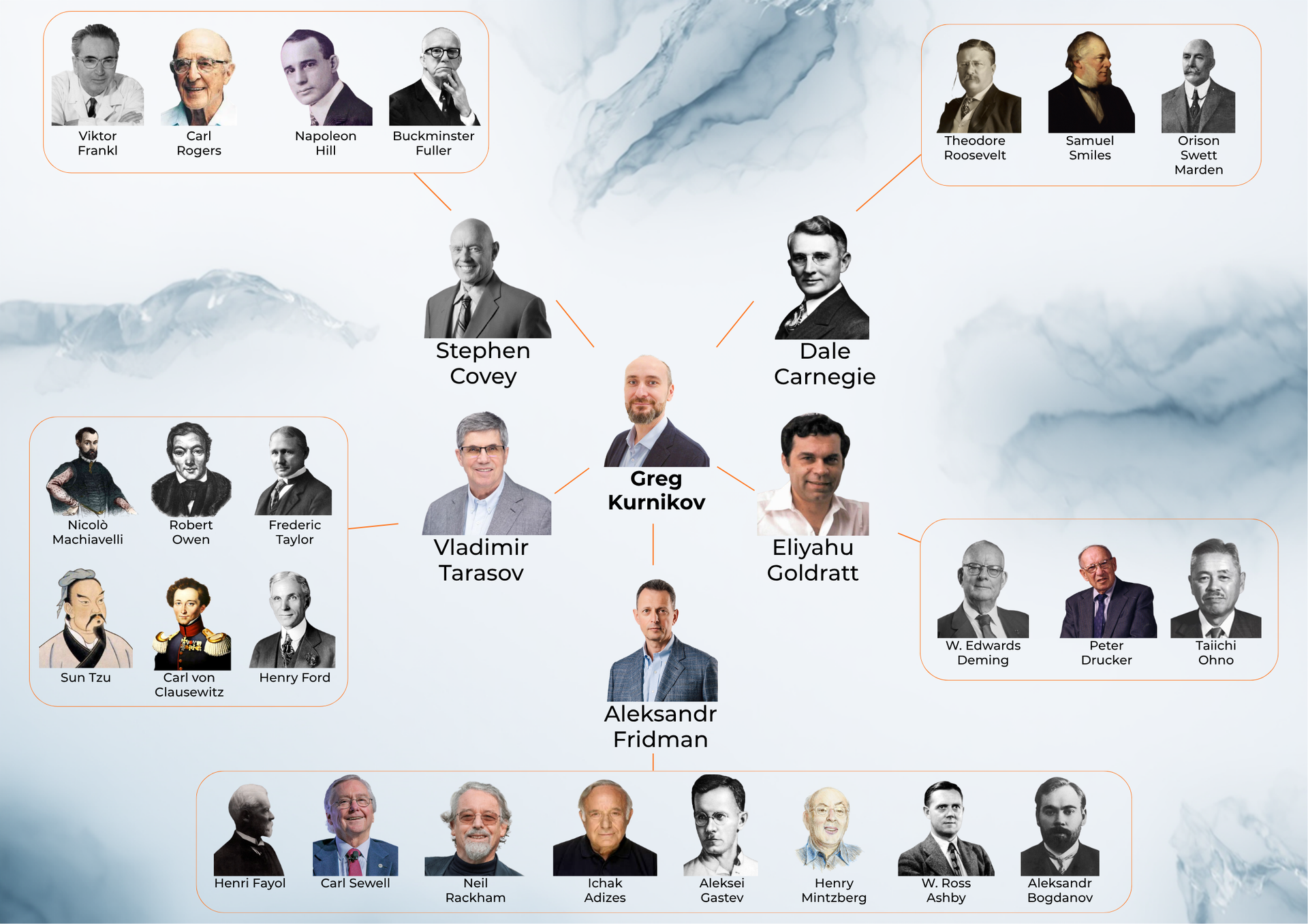
Every methodology has a lineage. Mine was shaped over time through operational pressure, leadership roles, hard lessons and serious study. The map behind Business Invincibility is broad, but it is not there to decorate the work. It shows where the method came from, what shaped it, and why it takes the form it does today. The thinkers on that map helped me sharpen how I look at strategy, structure, authority, execution, communication and organisational behaviour.
Business Invincibility itself is a practical operating discipline. In its simplest form, it is about building the internal strength that allows an organisation to perform reliably, stay credible under pressure and keep control when conditions tighten. In my own materials I describe it as the discipline of not losing: clarity of purpose, explicit ownership, enforceable standards and a leadership cadence that keeps performance under control. That definition did not emerge from theory alone. It came from years spent inside operations where the difference between order and disorder had commercial consequences.
Sun Tzu and the strategic foundation
At the centre of the map sits Sun Tzu. His influence on my work is foundational. Not because he is fashionable, but because his core logic remains highly relevant to modern organisational life. One idea in particular stayed with me: invincibility is created internally. In business terms, that means the real work starts long before the market tests you. It starts with how well the organisation is arranged, how clearly people understand the direction, how consistently standards are applied, and how much of the operation depends on control rather than improvisation. That logic now runs directly through my methodology.
Sun Tzu also shaped one of the clearest practical parts of my work: the Five Clarities. These are not abstract ideas for a workshop wall. They are operating conditions. People need clarity of purpose, clarity of the path, clarity of rules, clarity of role and clarity of criteria. When those are vague, organisations waste energy, argue over interpretation and drift into inconsistency. When they are clear, management becomes steadier and execution becomes more dependable. That is why this framework remains central in how I think about leadership and transformation.
Tarasov and managerial reality
If Sun Tzu provided the strategic foundation, Vladimir Tarasov sharpened the managerial lens. Tarasov’s work changed how I look at authority, discipline, responsibility and managerial judgement. One of his most useful ideas is the idea of an adequate worldview: a picture of reality that does not collapse when tested by events. He is also unusually strong on the distinction between what is solid and what is empty in an organisation’s understanding of itself. That matters in real management work. A company may look structured on paper and still be running on assumption, habit and wishful thinking. Tarasov teaches you to look for where the organisation’s picture of reality no longer matches what is actually happening.
That influence is visible in how I assess organisations today. I look closely at whether authority is real, whether responsibility is matched to decision rights, whether behavioural rules are lived rather than stated, and whether managers have a reliable grip on the true situation. Tarasov is also excellent on the importance of small details that later grow into bigger operational problems. That habit of looking carefully at the supposedly minor things has stayed with me for years. In practice, they are often the earliest signals that control is weakening.
Aleksandr Fridman shaped the execution side of my methodology more than almost anyone else. His work is exceptionally strong on the craft of management itself: delegation, control, planning, escalation, consistency and the difference between professional management and intuitive firefighting. That matters because many delivery problems are not caused by lack of effort. They come from unclear tasks, weak follow-up, inconsistent rules and managers staying busy without actually controlling the system. Fridman names those weaknesses with unusual clarity.
Fridman and execution discipline
His material on control, time eaters and the practical mechanics of operating discipline has had a direct influence on how I work. I pay close attention to whether managers define work clearly, whether the rules of execution are stable, whether follow-up is regular, and whether the organisation is losing time through badly designed routines. Fridman is especially useful because he treats management as a professional discipline rather than a personality trait. That is very close to how I see it myself. Good management should be teachable, repeatable and visible in practice.
Goldratt and systems thinking
Eliyahu Goldratt brought the systems discipline. His influence sits in how I look at flow, constraint, waste, trapped effort and the cost of solving the wrong problem. Goldratt taught generations of managers to stop treating organisations as disconnected fragments and to start looking at the chain as a whole. That way of thinking shaped a large part of my diagnostic work. When I assess an organisation, I want to know where work gets stuck, where management attention is misdirected, where operating expense is being inflated unnecessarily, and what the true bottleneck is.
That is why the Invincibility Blueprint uses a strong Goldratt lens. The method note and reference structure behind it explicitly use Goldratt to judge throughput, done-to-paid flow, bottlenecks, trapped inventory, returns loops and operating expense inflation. That systems view matters because surface activity can easily hide the real source of drag. Goldratt’s work helped me become much stricter about separating noise from constraint and symptom from cause.
The human side of the method
Alongside the strategic and systems tradition sits another important strand: the thinkers who shaped how I understand people, communication and leadership behaviour. Stephen Covey and Dale Carnegie are important here, and the wider map also includes figures such as Viktor Frankl and Carl Rogers. These influences matter because organisations are never made of systems alone. They are made of people working inside systems. Covey’s emphasis on principles, direction and meaningful priorities strengthened my thinking on leadership focus and internal alignment. Carnegie reinforced the practical discipline of dealing with people properly, especially in the areas of influence, communication and respect. The map I shared includes all of these names because they genuinely shaped the way I think and work.
A method shaped by many traditions
The full map includes many others as well: Clausewitz, Machiavelli, Deming, Drucker, Ohno, Mintzberg, Fayol, Ford, Owen, Taylor, Adizes, Ashby, Bogdanov, Rackham, Fuller and others. I do not treat them as a reading list to quote from. I see them as part of a wider management lineage that contributed something important to the work: sharper judgement, clearer structure, stronger systems thinking, better operational discipline, or a better understanding of human behaviour.
What matters is not imitation. What matters is taking what stands up in practice, integrating it properly, and applying it in the context of modern business. So when I talk about Business Invincibility, I am talking about a methodology with roots. It was shaped by strategy, management science, organisational design, behavioural thinking and operational reality. It carries the influence of mentors who treated management seriously and expected structure, discipline and clarity to show up in practice. That is the lineage behind the method, and it explains why my work is so focused on building organisations that can hold their shape when pressure rises.